Optimization
Objectives
Introduction
An optimization objective is the performance metric that's used to compare the backtest performance of different parameter values. The optimizer currently supports the compound annual growth rate (CAGR), drawdown, Sharpe ratio, and Probabilistic Sharpe ratio (PSR) as optimization objectives. When the optimization job finishes, the results page displays the value of the objective with respect to the parameter values.
CAGR
The annual percentage return that would be required to grow a portfolio from its starting value to its ending value.
It is calculated as
$$ \text{CAGR} = \left(\frac{e}{s}\right)^{\frac{1}{y}} - 1 $$where $s$ is starting equity, $e$ is ending equity, and $y$ is the number of years in the backtest period.
The benefit of using CAGR as the objective is that it maximizes the return of your algorithm over the entire backtest. The drawback of using CAGR is that it may cause your algorithm to have more volatile returns, which increases the difficulty of keeping your algorithm deployed in live mode.
Drawdown
The largest peak to trough decline in an algorithm's equity curve.
It is calculated as
$$ 1 - \frac{v^{t \ge s}_{\text{min}}}{v^s_{\text{max}}} $$where $v^s_{\text{max}}$ is the maximum equity value up to time $s$ and $v^{t \ge s}_{\text{min}}$ is the minimum equity value at time $t$ where $t \ge s$.
The following image illustrates how the max drawdown is calculated:
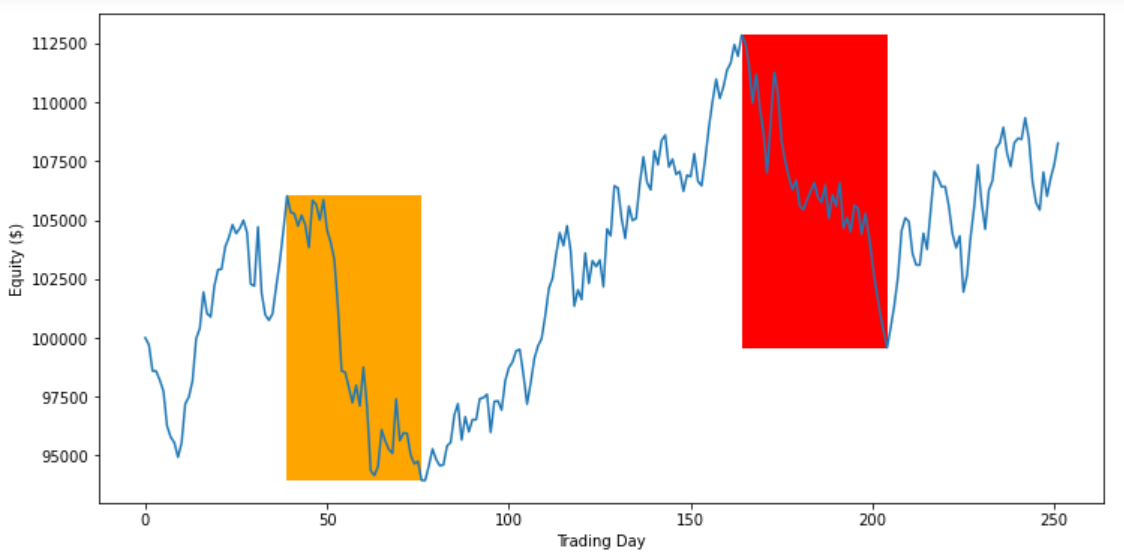
During the first highlighted period in the preceding image, the equity curve dropped from 106,027 to 93,949 (11.4%). During the second highlighted period, the equity curve dropped from 112,848 to 99,576 (11.8%). Since 11.8% > 11.4%, the max drawdown of the equity curve is 11.8%.
The benefit of using drawdown as the objective is that it's psychologically easier to keep an algorithm deployed in live mode if the algorithm doesn't experience large drawdowns. The drawback of using drawdown is that it may limit the potential returns of your algorithm.
Sharpe
A measure of the risk-adjusted return, developed by William Sharpe.
It is calculated as
$$ SR = \frac{E[R_p - R_b]}{\sigma_p} $$where $R_p$ is the return of the portfolio, $R_b$ is the return of the benchmark, and $\sigma_p$ is the standard deviation of the portfolio's excess returns. By default, LEAN uses a 0% risk-free rate, so $R_b = 0$. For more information about the Sharpe ratio, see Sharpe (1994).
The benefit of using the Sharpe ratio as the objective is that it maximizes returns while minimizing the return volatility. It's usually psychologically easier to keep a live algorithm deployed if it has minimal swings in equity than if it has large swings in equity. The drawback of using the Sharpe ratio is that it may limit your potential returns in favor of a less volatile equity curve.
PSR
The probability that the estimated Sharpe ratio of an algorithm is greater than a benchmark.
It is calculated as
\[ P\left(\hat{SR} > SR^{\ast}\right) = CDF\left(\frac{(\hat{SR} - SR^{\ast})\sqrt{n-1}}{\sqrt{1 - \hat{\gamma}_{3}\hat{SR} + \frac{\hat{\gamma}_{4}-1}{4}\hat{SR}^{2}}}\right) \]where $SR^{\ast}$ is the Sharpe ratio of the benchmark, $\hat{SR}$ is the Sharpe ratio of the algorithm, $n$ is the number of trading days, $\hat{\gamma}_{3}$ is the skewness of the algorithm's returns, $\hat{\gamma}_{4}$ is the kurtosis of the algorithm's returns, and $CDF$ is the normal cumulative distribution function. For more information about the PSR, see Bailey and López de Prado (2012).
The benefit of using the PSR as the objective is that it maximizes the probability of your algorithm's Sharpe ratio outperforming the benchmark Sharpe ratio. The drawback of using the PSR is that, like the Sharpe ratio objective, optimizing the PSR may limit your potential returns in favor of a less volatile equity curve.
Constraints
Constraints filter out backtests from your optimization results that do not conform to your desired range of statistical results. Constraints consist of a target, operator, and a numerical value. For instance, you can add a constraint that the optimization backtests must have a Sharpe ratio >= 1 to be included in the optimization results. Constraints are optional, but you can use them to incorporate multiple objective functions into a single optimization job.
You can also see our Videos. You can also get in touch with us via Discord.
Did you find this page helpful?
