Option Strategies
Short Iron Condor
Introduction
The Short Iron Condor is an Option strategy that consists of four contracts. All the contracts have the same underlying Equity and expiration, but the order of strike prices is $A>B>C>D$. The following table describes the strike prices of each contract:
| Position | Strike |
|---|---|
| -1 far-OTM call | $A$ |
| 1 near-OTM call | $B, where B > underlying\ price$ |
| 1 near-OTM put | $C, where C < underlying\ price$ |
| -1 far-OTM put | $D, where C-D = A-B$ |
The short iron condor consists of selling a far OTM call, selling a far OTM put, buying a near OTM call, and buying a near OTM put. This strategy profits from a increase in price movement (implied volatility).
Implementation
Follow these steps to implement the short iron condor strategy:
- In the
Initializeinitializemethod, set the start date, end date, cash, and Option universe. - In the
OnDataon_datamethod, select the contracts in the strategy legs. - In the
OnDataon_datamethod, place the orders.
private Symbol _symbol;

public override void Initialize()
{
    SetStartDate(2024, 9, 1);
    SetEndDate(2024, 12, 31);
    SetCash(500000);

    UniverseSettings.Asynchronous = true;
    var option = AddOption("GOOG");
    _symbol = option.Symbol;
    option.SetFilter(universe => universe.IronCondor(30, 5, 10));
}
def initialize(self) -> None:
self.set_start_date(2024, 9, 1)
self.set_end_date(2024, 12, 31)
self.set_cash(500000)
self.universe_settings.asynchronous = True
option = self.add_option("GOOG")
self._symbol = option.symbol
option.set_filter(lambda universe: universe.iron_condor(30, 5, 10))
The IronCondoriron_condor filter narrows the universe down to just the four contracts you need to form a short iron condor.
public override void OnData(Slice slice)
{
    if (Portfolio[_symbol.Underlying].Invested)
    {
        Liquidate();
    }

    if (Portfolio.Invested || !IsMarketOpen(_symbol) ||
        !slice.OptionChains.TryGetValue(_symbol, out var chain))
    {
        return;
    }

    // Find put and call contracts with the farthest expiry
    var expiry = chain.Max(x => x.Expiry);
    var contracts = chain.Where(x => x.Expiry == expiry).OrderBy(x => x.Strike);

    var putContracts = contracts.Where(x => x.Right == OptionRight.Put).ToArray();
    var callContracts = contracts.Where(x => x.Right == OptionRight.Call).ToArray();

    if (putContracts.Length < 2 || callContracts.Length < 2) return;

    // Select the strategy legs
    var farPut = putContracts[0];
    var nearPut = putContracts[1];
    var nearCall = callContracts[0];
    var farCall = callContracts[1];
def on_data(self, slice: Slice) -> None:
if self.portfolio[self._symbol.underlying].invested:
self.liquidate()
if self.portfolio.invested or not self.is_market_open(self._symbol):
return
chain = slice.option_chains.get(self._symbol)
if not chain:
return
# Find put and call contracts with the farthest expiry
expiry = max([x.expiry for x in chain])
chain = sorted([x for x in chain if x.expiry == expiry], key = lambda x: x.strike)
put_contracts = [x for x in chain if x.right == OptionRight.PUT]
call_contracts = [x for x in chain if x.right == OptionRight.CALL]
if len(call_contracts) < 2 or len(put_contracts) < 2:
return
# Select the strategy legs
far_put = put_contracts[0]
near_put = put_contracts[1]
near_call = call_contracts[0]
far_call = call_contracts[1]
Approach A: Call the OptionStrategies.ShortIronCondorOptionStrategies.short_iron_condor method with the details of each leg and then pass the result to the Buybuy method.
var shortIronCondor = OptionStrategies.ShortIronCondor(
    _symbol,
    farPut.Strike,
    nearPut.Strike,
    nearCall.Strike,
    farCall.Strike,
    expiry);

Buy(shortIronCondor, 2);
short_iron_condor = OptionStrategies.short_iron_condor(
self._symbol,
far_put.strike,
near_put.strike,
near_call.strike,
far_call.strike,
expiry)
self.buy(short_iron_condor, 2)
Approach B: Create a list of Leg objects and then call the Combo Market Ordercombo_market_order, Combo Limit Ordercombo_limit_order, or Combo Leg Limit Ordercombo_leg_limit_order method.
var legs = new List<Leg>()
{
Leg.Create(farPut.Symbol, -1),
Leg.Create(nearPut.Symbol, 1),
Leg.Create(farCall.Symbol, -1),
Leg.Create(nearCall.Symbol, 1)
};
ComboMarketOrder(legs, 1); legs = [
Leg.create(far_put.symbol, -1),
Leg.create(near_put.symbol, 1),
Leg.create(far_call.symbol, -1),
Leg.create(near_call.symbol, 1)
]
self.combo_market_order(legs, 1)
Strategy Payoff
This is a limited-reward-limited-risk strategy. The payoff is
$$ \begin{array}{rcll} C^{far}_T & = & (S_T - K^C_{far})^{+}\\ C^{near}_T & = & (S_T - K^C_{near})^{+}\\ P^{far}_T & = & (K^P_{far} - S_T)^{+}\\ P^{near}_T & = & (K^P_{near} - S_T)^{+}\\ P_T & = & (C^{near}_T + P^{near}_T - C^{far}_T - P^{far}_T - C^{near}_0 - P^{near}_0 + C^{far}_0 + P^{far}_0)\times m - fee \end{array} $$ $$ \begin{array}{rcll} \textrm{where} & C^{far}_T & = & \textrm{Far OTM call value at time T}\\ & C^{near}_T & = & \textrm{Near OTM call value at time T}\\ & P^{far}_T & = & \textrm{Far OTM put value at time T}\\ & P^{near}_T & = & \textrm{Near ATM put value at time T}\\ & S_T & = & \textrm{Underlying asset price at time T}\\ & K^C_{far} & = & \textrm{Far OTM call strike price}\\ & K^C_{near} & = & \textrm{Near OTM call strike price}\\ & K^P_{far} & = & \textrm{Far OTM put strike price}\\ & K^P_{near} & = & \textrm{Near OTM put strike price}\\ & P_T & = & \textrm{Payout total at time T}\\ & C^{far}_0 & = & \textrm{Far OTM call value at position opening (credit received)}\\ & C^{near}_0 & = & \textrm{Near OTM call value at position opening (debit paid)}\\ & P^{far}_0 & = & \textrm{Far OTM put value at position opening (credit received)}\\ & P^{near}_0 & = & \textrm{Near OTM put value at position opening (debit paid)}\\ & m & = & \textrm{Contract multiplier}\\ & T & = & \textrm{Time of expiration} \end{array} $$In this example, the underlying stock price at expiration is $843.25. You traded a far-OTM call at $857.50 for $1.05, a near-OTM call at $852.50 for $2.75, a far-OTM put at $815.00 for $2.15, and a near-OTM put at $820.00 for $4.80.
The following chart shows the payoff at expiration:
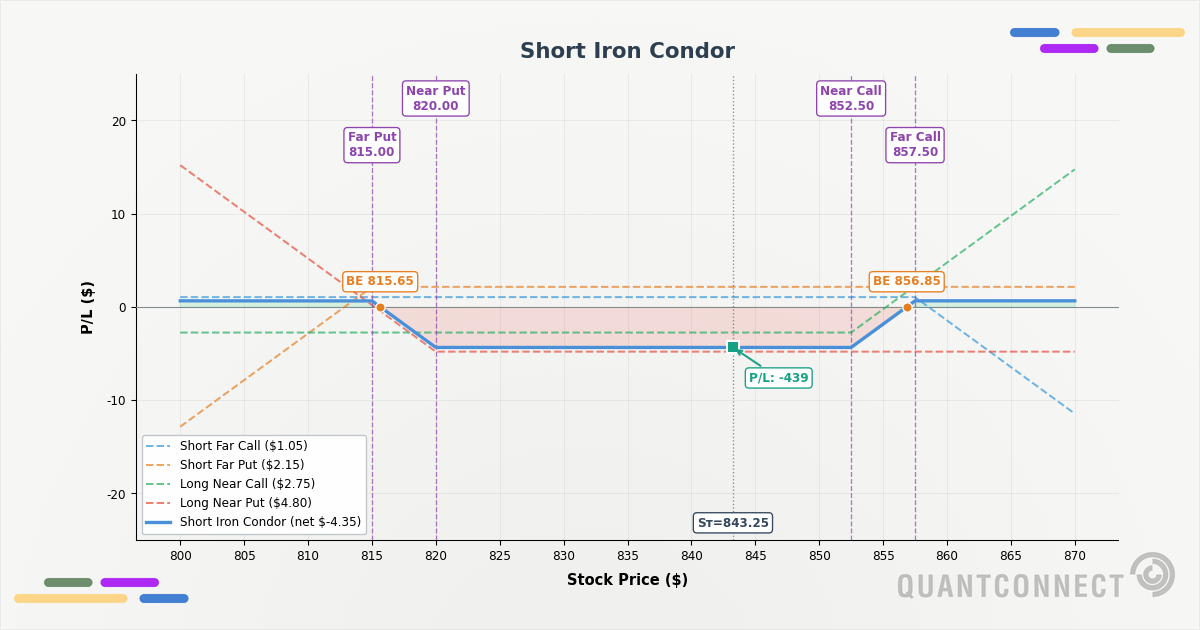
The maximum profit is $K^C_{far} - K^C_{near} - C^{near}_0 - P^{near}_0 + C^{far}_0 + P^{far}_0$, where $K^P_{OTM} > S_T$ or $S_T > K^C_{OTM}$.
The maximum loss is the net debit paid: $C^{far}_0 + P^{far}_0 - C^{near}_0 - P^{near}_0$, where $K^P_{OTM} < S_T < K^C_{OTM}$.
If the Option is American Option, there is a risk of early assignment on the contracts you sell.
Example
The following table shows the price details of the assets in the algorithm:
| Asset | Price ($) | Strike ($) |
|---|---|---|
| Far-OTM call | 1.05 | 857.50 |
| Far-OTM put | 2.15 | 815.00 |
| Near-OTM call | 2.75 | 852.50 |
| Near-OTM put | 4.80 | 820.00 |
| Underlying Equity at expiration | 843.25 | - |
Therefore, the payoff is
$$ \begin{array}{rcll} C^{far}_T & = & (S_T - K^C_{far})^{+}\\ & = & (843.25-857.50)^{+}\\ & = & 0\\ C^{near}_T & = & (S_T - K^C_{near})^{+}\\ & = & (843.25-852.50)^{+}\\ & = & 0\\ P^{far}_T & = & (K^P_{far} - S_T)^{+}\\ & = & (815.00-843.25)^{+}\\ & = & 0\\ P^{near}_T & = & (K^P_{near} - S_T)^{+}\\ & = & (820.00-843.25)^{+}\\ & = & 0\\ P_T & = & (C^{near}_T + P^{near}_T - C^{far}_T - P^{far}_T - C^{near}_0 - P^{near}_0 + C^{far}_0 + P^{far}_0)\times m - fee\\ & = & (0+0-0-0-2.75-4.80+1.05+2.15)\times100-1\times4\\ & = & -439 \end{array} $$So, the strategy loses $439.
The following algorithm implements a short iron condor Option strategy:
public class ShortIronCondorStrategy : QCAlgorithm
{
private Symbol _symbol;
public override void Initialize()
{
SetStartDate(2024, 9, 1);
SetEndDate(2024, 12, 31);
SetCash(100000);
var option = AddOption("GOOG", Resolution.Minute);
_symbol = option.Symbol;
option.SetFilter(universe => universe.IronCondor(30, 5, 10));
}
public override void OnData(Slice slice)
{
if (Portfolio.Invested || !IsMarketOpen(_symbol) ||
!slice.OptionChains.TryGetValue(_symbol, out var chain))
{
return;
}
// Find put and call contracts with the farthest expiry
var expiry = chain.Max(x => x.Expiry);
var contracts = chain.Where(x => x.Expiry == expiry).OrderBy(x => x.Strike);
var putContracts = contracts.Where(x => x.Right == OptionRight.Put).ToArray();
var callContracts = contracts.Where(x => x.Right == OptionRight.Call).ToArray();
if (putContracts.Length < 2 || callContracts.Length < 2) return;
// Select the strategy legs
var nearCall = callContracts[0];
var farCall = callContracts[1];
var nearPut = putContracts[1];
var farPut = putContracts.Single(x => x.Strike == nearPut.Strike - farCall.Strike + nearCall.Strike);
// Order Strategy
var shortIronCondor = OptionStrategies.ShortIronCondor(
_symbol,
farPut.Strike,
nearPut.Strike,
nearCall.Strike,
farCall.Strike,
expiry);
Buy(shortIronCondor, 2);
}
} class ShortIronCondorOptionStrategy(QCAlgorithm):
def initialize(self) -> None:
self.set_start_date(2024, 9, 1)
self.set_end_date(2024, 12, 31)
self.set_cash(100000)
option = self.add_option("GOOG", Resolution.MINUTE)
self._symbol = option.symbol
# set our strike/expiry filter for this option chain
option.set_filter(lambda x: x.iron_condor(30, 5, 10))
def on_data(self, slice: Slice) -> None:
if self.portfolio.invested or not self.is_market_open(self._symbol):
return
chain = slice.option_chains.get(self._symbol)
if not chain:
return
# Find put and call contracts with the farthest expiry
expiry = max([x.expiry for x in chain])
chain = sorted([x for x in chain if x.expiry == expiry], key = lambda x: x.strike)
put_contracts = [x for x in chain if x.right == OptionRight.PUT]
call_contracts = [x for x in chain if x.right == OptionRight.CALL]
if len(call_contracts) < 2 or len(put_contracts) < 2:
return
# Select the strategy legs
near_call = call_contracts[0]
far_call = call_contracts[1]
near_put = put_contracts[1]
far_put = [x for x in put_contracts if x.strike == near_put.strike - far_call.strike + near_call.strike][0]
short_iron_condor = OptionStrategies.short_iron_condor(
    self._symbol,
    far_put.strike,
    near_put.strike,
    near_call.strike,
    far_call.strike,
    expiry)

self.buy(short_iron_condor, 2)
You can also see our Videos. You can also get in touch with us via Discord.
Did you find this page helpful?
